
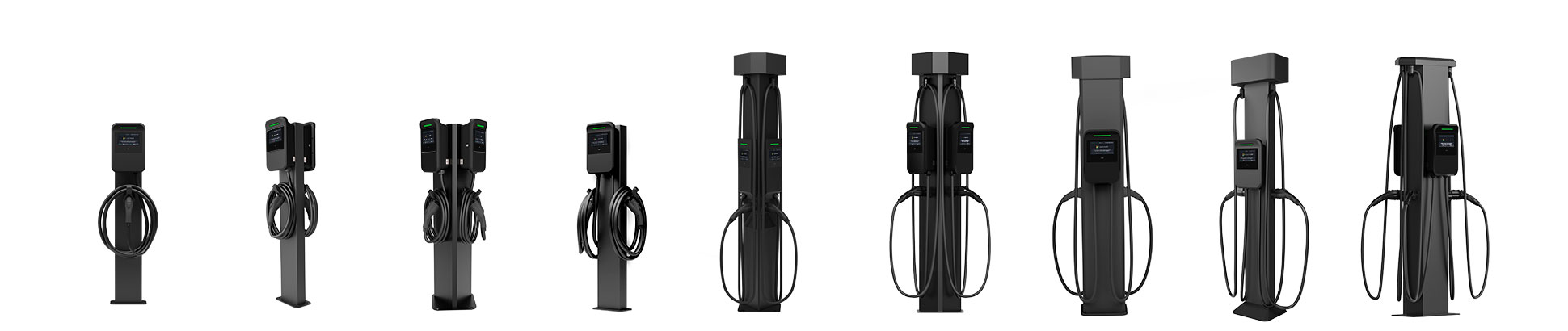

1. Introduction to DC charging pile
In recent years, the rapid growth of electric vehicles (EVs) has driven the demand for more efficient and intelligent charging solutions. DC charging piles, known for their fast charging capabilities, are at the forefront of this transformation. With advancements in technology, efficient DC chargers are now designed to optimize charging time, improve energy utilization, and offer seamless integration with smart grids.
With the continuous increase in market volume, the implementation of bidirectional OBC (On-Board Chargers) not only helps alleviate consumer concerns about range and charging anxiety by enabling fast charging but also allows electric vehicles to function as distributed energy storage stations. These vehicles can return power to the grid, assisting in peak shaving and valley filling. Efficient charging of electric vehicles via DC fast chargers (DCFC) is a major trend in promoting renewable energy transitions. Ultra-fast charging stations integrate various components such as auxiliary power supplies, sensors, power management, and communication devices. At the same time, flexible manufacturing methods are required to meet the evolving charging demands of different electric vehicles, adding complexity to the design of DCFC and ultra-fast charging stations.
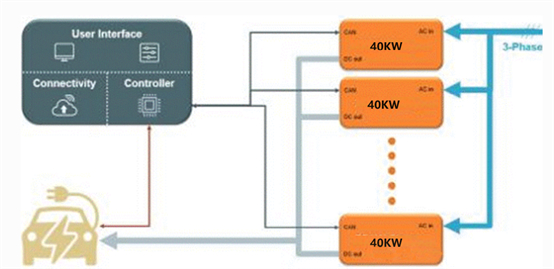
The difference between AC charging and DC charging, for AC charging (left side of Figure 2), plug the OBC into a standard AC outlet, and the OBC converts AC to the appropriate DC to charge the battery. For DC charging (right side of Figure 2), the charging post charges the battery directly.
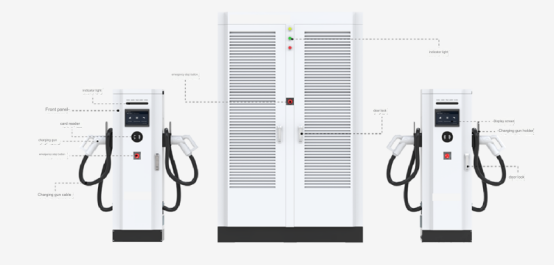
 2. DC charging pile system composition
(1) Complete machine components
(2) System components
 (3) Functional block diagram
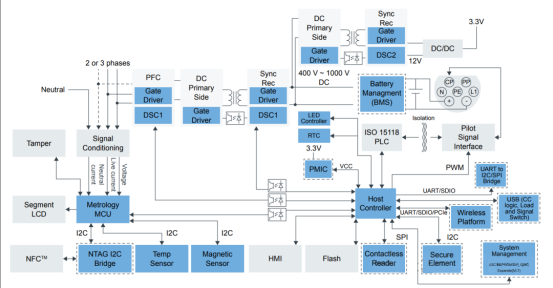 (4) Charging pile subsystem
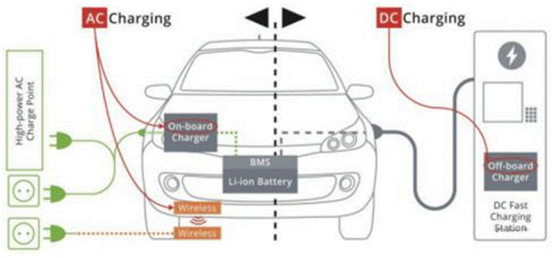
Level 3 (L3) DC fast chargers bypass the on-board charger (OBC) of an electric vehicle by charging the battery directly via the EV’s Battery Management System (BMS). This bypass leads to a significant increase in charging speed, with charger output power ranging from 50 kW to 350 kW. The output voltage typically varies between 400V and 800V, with newer EVs trending toward 800V battery systems. Since L3 DC fast chargers convert three-phase AC input voltage into DC, they use an AC-DC power factor correction (PFC) front-end, which includes an isolated DC-DC converter. This PFC output is then linked to the vehicle's battery. To achieve higher power output, multiple power modules are often connected in parallel. The main benefit of L3 DC fast chargers is the considerable reduction in charging time for electric vehicles
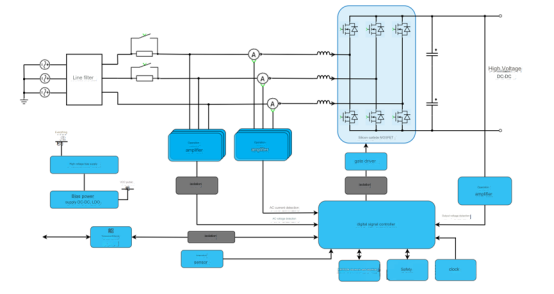
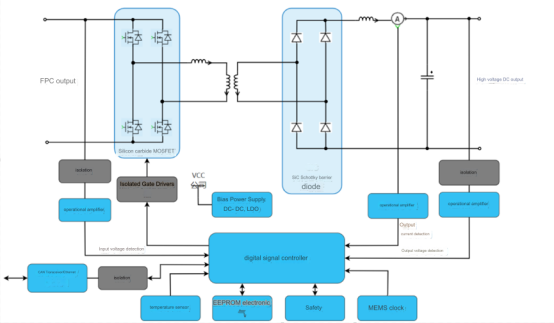
 The charging pile core is a basic AC-DC converter. It consists of PFC stage, DC bus and DC-DC module
PFC Stage Block Diagram
 DC-DC module functional block diagram
3. Charging pile scenario scheme
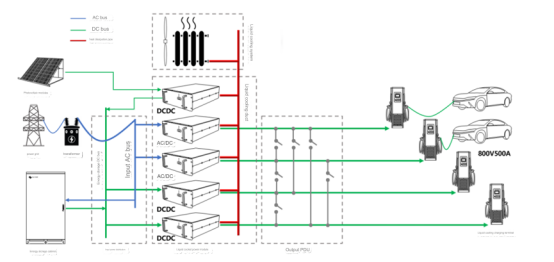
(1) Optical storage charging system
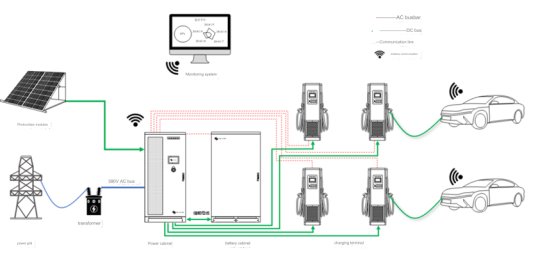
As the charging power of electric vehicles increases, the power distribution capacity at charging stations often struggles to meet the demand. To address this issue, a storage-based charging system utilizing a DC bus has emerged. This system uses lithium batteries as the energy storage unit and employs local and remote EMS (Energy Management System) to balance and optimize the supply and demand of electricity between the grid, the storage batteries, and the electric vehicles. Additionally, the system can easily integrate with photovoltaic (PV) systems, providing significant advantages in peak and off-peak electricity pricing and grid capacity expansion, thereby improving overall energy efficiency.
 (2) V2G charging system
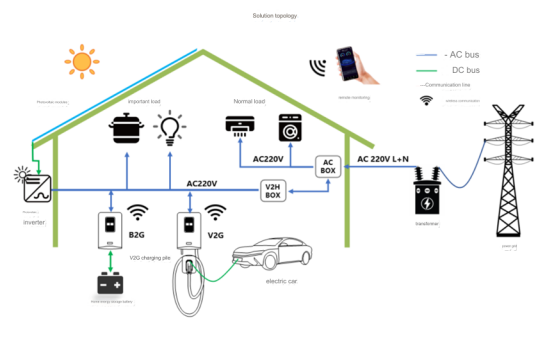
Vehicle-to-Grid (V2G) technology utilizes EV batteries to store energy, supporting the power grid by enabling interaction between vehicles and the grid. This reduces the strain caused by integrating large-scale renewable energy sources and widespread EV charging, ultimately enhancing grid stability. Additionally, in areas such as residential neighborhoods and office complexes, numerous electric vehicles can take advantage of peak and off-peak pricing, manage dynamic load increases, respond to grid demand, and provide backup power, all through centralized EMS (Energy Management System) control. For households, Vehicle-to-Home (V2H) technology can transform EV batteries into a home energy storage solution.
 (3) Ordered charging system
The ordered charging system primarily utilizes high-power fast charging stations, ideal for concentrated charging needs like public transit, taxis, and logistics fleets. Charging schedules can be customized based on vehicle types, with charging taking place during off-peak electricity hours to lower costs. Additionally, an intelligent management system can be implemented to streamline centralized fleet management.
4.Future development trend
(1) Coordinated development of diversified scenarios supplemented by centralized + distributed charging stations from single centralized charging stations
Destination-based distributed charging stations will serve as a valuable addition to the enhanced charging network. Unlike centralized stations where users actively seek out chargers, these stations will integrate into locations people are already visiting. Users can charge their vehicles during extended stays (typically over an hour), where fast charging is not critical. The charging power of these stations, typically ranging from 20 to 30 kW, is sufficient for passenger vehicles, providing a reasonable level of power to meet basic needs.
(2) 20kW large share market to 20/30/40/60kW diversified configuration market development
With the shift toward higher voltage electric vehicles, there is a pressing need to increase the maximum charging voltage of charging piles to 1000V to accommodate the future widespread use of high-voltage models. This move supports the necessary infrastructure upgrades for charging stations. The 1000V output voltage standard has gained broad acceptance in the charging module industry, and key manufacturers are progressively introducing 1000V high-voltage charging modules to meet this demand.
Linkpower has been dedicated to providing R&D including software, hardware and appearance for AC/DC electric vehicle charging piles for more than 8 years. We have obtained ETL / FCC / CE / UKCA / CB / TR25 / RCM certificates. Using OCPP1.6 software, we have completed testing with more than 100 OCPP platform providers. We have upgraded OCPP1.6J to OCPP2.0.1, and the commercial EVSE solution has been equipped with the IEC/ISO15118 module, which is a solid step towards realizing V2G bi-directional charging.
In the future, high-tech products such as electric vehicle charging piles, solar photovoltaic, and lithium battery energy storage systems (BESS) will be developed to provide a higher level of integrated solutions for customers around the world.
Post time: Oct-17-2024