
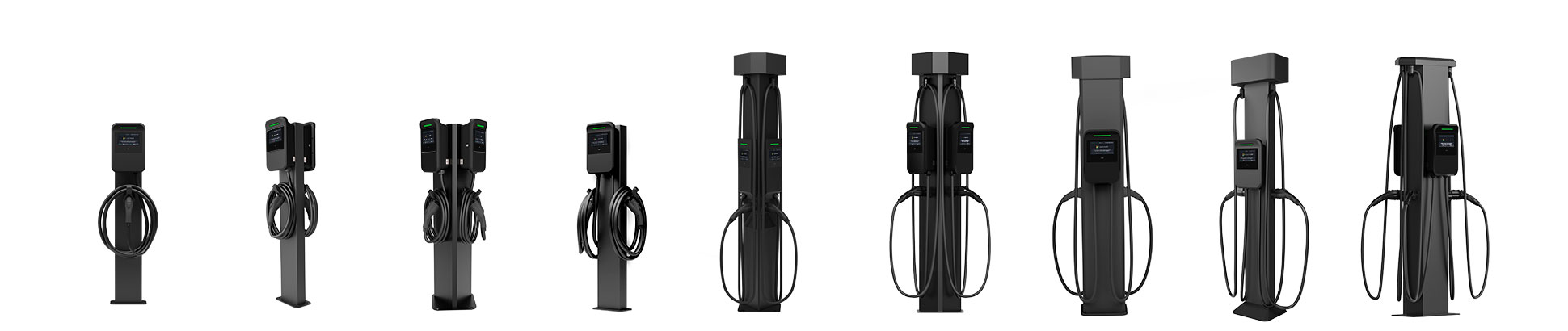

Quick Summary: Who Pays for Free EV Charging? Free EV charging is typically paid for by retailers, corporate employers, or municipalities as a strategic investment. These hosts monetize the "free" service through increased customer dwell time, government incentives (like NEVI), or by absorbing electricity costs as a marketing OpEx to boost overall ROI.
For Electric Vehicle (EV) owners, seeing "Free Charging" on a map feels like a win. But economically, there is no such thing as a free lunch. Since the driver isn't paying, who exactly is footing the bill?
As an EV charger manufacturer deeply rooted in the global supply chain, we don't just see the "free" service; we see the invoices behind it. In 2026, free charging is no longer just a perk—it is a calculated business strategy backed by complex CapEx and OpEx models.
This analysis reveals the financial structures behind free electricity and, for business owners, demonstrates how to use Smart Load Management and Incentive Stacking to make the "free model" profitable.
Table Of Contents
I. Why "Free Charging" Isn't Really Free: 2026 Global Trends
When you plug in your car and don't have to swipe a card, the cost hasn't disappeared. It has simply been shifted.
In most cases, these costs are absorbed by the following parties:
•Retailers & Businesses (Hoping you will shop inside)
•Employers (As an employee benefit)
•Governments & Municipalities (For environmental goals)
•Automakers (To sell more cars)
Additionally, government policy subsidies play a decisive supporting role. To accelerate the transition to electric mobility, governments worldwide are paying for free charging through an "invisible hand."
According to the U.S. Federal Highway Administration's NEVI Formula Program Guidance (2022-2026), the federal government has allocated $5 billion in dedicated funding to cover up to 80% of charging station construction costs.
Data Note: While NEVI covers capital costs, it mandates a minimum of 97% uptime reliability. This requirement shifts significant financial pressure to operational maintenance (OpEx)—a cost often absorbed by site hosts in exchange for retail foot traffic.
Manufacturer's Insider View: The "Free" model directly changes how we design charging stations. If a site decides to offer free service, we usually recommend limiting the charging power. Why? Because excessively high power means high equipment wear and electricity costs, which is unsustainable for site hosts offering "free" services.
II. The Two Core Costs of Free Charging: CapEx vs. OpEx Explained
To understand who pays, you first need to understand what's on the bill. For any business looking to install chargers, costs fall into two categories:
1. CapEx: Capital Expenditures (One-time Investment)
This is the cost of the charging station's "birth."
•Hardware Costs: According to the latest report from the National Renewable Energy Laboratory (NREL), the hardware cost for a single Direct Current Fast Charger (DCFC) typically ranges from $25,000 to $100,000+, depending on power output. In contrast, Level 2 (AC) chargers range from $400 to $6,500.
•Infrastructure: Trenching, cabling, and transformer upgrades. NREL notes that this part varies wildly and can sometimes exceed the cost of the equipment itself.
•Permitting & Certification: Government approval processes.
How does the manufacturer help you save money? As a source factory, we know how to slash CapEx:
•Modular Design: If a module fails, you only need to replace the module, not the entire pile. This drastically lowers long-term ownership costs.
•Pre-commissioning Service: Our equipment is commissioned before leaving the factory. This means field installers just need to "Plug and Play" (ISO 15118), saving expensive labor hours.
•Flexible Installation Solutions: Support for seamless switching between wall-mount and pedestal mounting, adapting to constrained spaces without expensive custom foundation engineering, reducing civil work expenses.
•Full Compliance Certification: We provide full sets of international certification documents (ETL, UL, CE, etc.) to ensure you pass government approval "the first time," avoiding project delays and secondary rectification costs due to compliance issues.
2. OpEx: Operating Expenses (Ongoing Costs)
This is the cost of the charging station "living," often overlooked but fatal to profitability.
•Energy Charges: This isn't just paying for every kWh used, but also when it is used. Commercial electricity often uses Time-of-Use (TOU) rates, where peak prices can be 3x higher than off-peak.
•Demand Charges: This is the true "nightmare" for many operators. A deep dive study by the Rocky Mountain Institute (RMI) titled "Reducing EV Charging Infrastructure Costs" points out that at some low-utilization fast-charging stations, demand charges can account for over 90% of the monthly electric bill.
Methodology Insight: This happens because utilities typically calculate demand fees based on the single highest 15-minute interval of energy usage in a billing cycle, not the total energy consumed. Even if you have just one spike in usage all month, the utility charges a capacity fee for the entire month based on that momentary peak.
•Maintenance & Network Fees: Includes OCPP platform subscription fees and expensive "Truck Rolls." A simple on-site reboot or module replacement often incurs labor and travel costs of $300-$500.
Factory Tech Reveal: OpEx can be "designed" away. As a manufacturer, we help you save money through High Efficiency & Smart Thermal Control.
•High-Efficiency Modules: Our modules have an efficiency of up to 96% (compared to the market common 92%). This means less electricity is wasted as heat. For a site using 100,000 kWh annually, this 4% efficiency boost directly saves thousands of dollars in electricity bills.
•Smart Lifespan Management: Lower heat generation means cooling fans spin slower and suck in less dust, extending module lifespan by over 30%. This directly cuts down on later maintenance frequency and replacement costs.
III. Comparison of Common International Free Charging Business Models
To make it clearer, we have organized the 5 current mainstream free charging models.
| Model Type | Who Pays? | Core Motivation (Why) | Manufacturer's Technical Value |
|---|---|---|---|
| 1. Site-Host Owned | Retailers, Hotels, Malls | Attract Foot Traffic, Increase Dwell Time, Boost Basket Size | Low TCO equipment; Multi-gun design to improve turnover rate. |
| 2. CPO Model | Charging Operators (e.g., ChargePoint) | Data Monetization, Brand Ads, Conversion to Paid Membership | OCPP API for fast integration, reducing software costs. |
| 3. Utility Model | Power Companies (Grid) | Grid Balancing, Data Collection, Guiding Off-peak Charging | Industrial-grade DC tech meeting strict grid stability requirements. |
| 4. Municipality/Gov | Taxpayer Funds | Public Service, Carbon Reduction, City Image | UL/CE full certification ensuring compliance and safety. |
| 5. Workplace Charging | Employers/Corporations | Talent Retention, ESG Corporate Image | Smart Load Balancing to prevent tripping site breakers. |
IV. Why Are Operators Willing to Provide Free Charging?
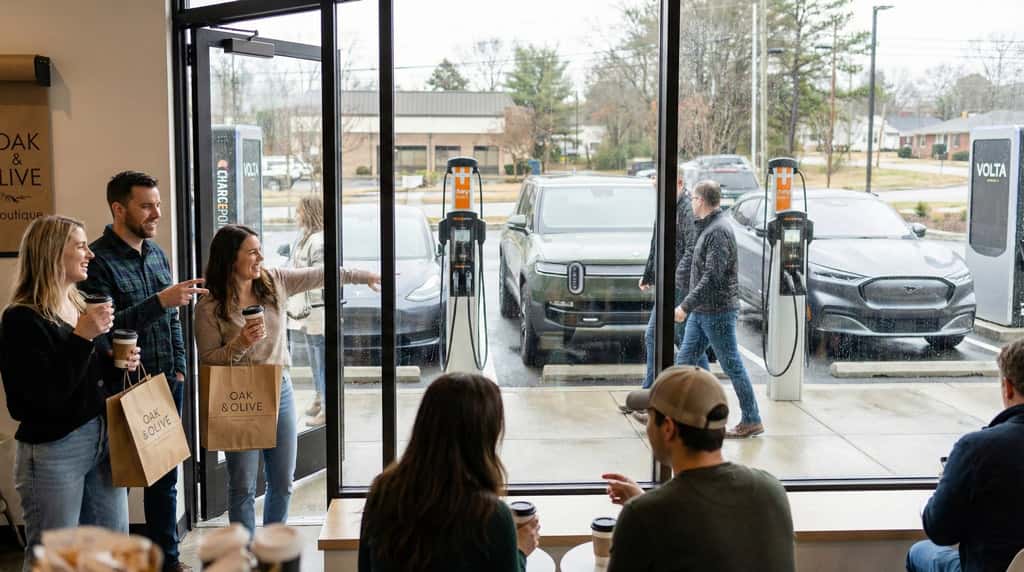
It sounds like charity, but it's actually shrewd business.
1. Attracting High-Value Customers EV owners typically have higher disposable income. If Walmart offers free charging, an owner might spend hundreds of dollars in-store just to save a few dollars on electricity. In retail, this is known as a "Loss Leader."
2. Increasing Dwell Time According to analysis by Atlas Public Policy, the average paid charging session for public fast charging is about 42 minutes. This means customers have nearly an hour where they must stay at the location. This "forced" dwell time is what retailers dream of.
3. Data Collection Your charging habits, vehicle model, and dwell time are all valuable big data.
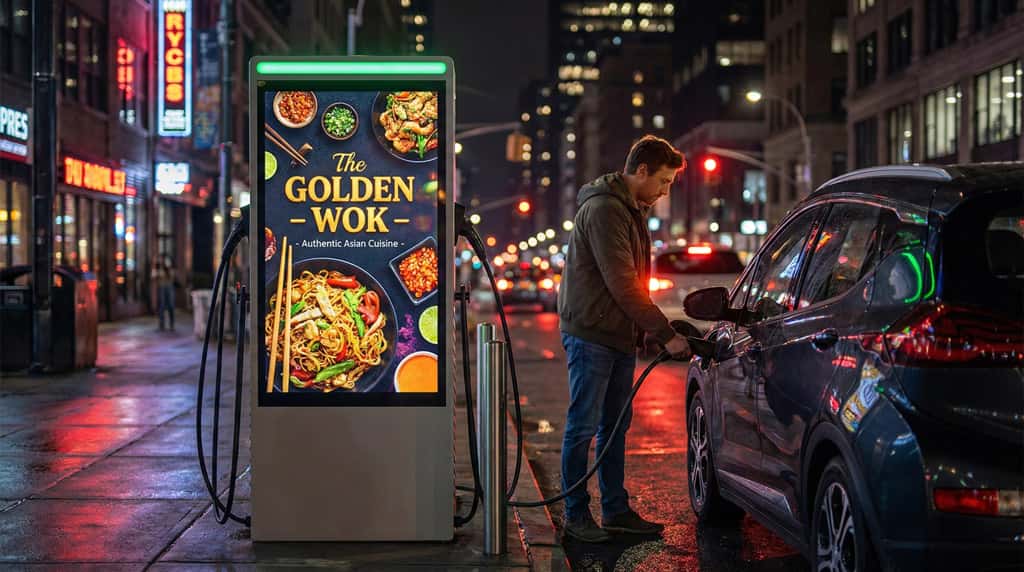
4. Ad Revenue Sharing Many modern chargers are equipped with high-definition screens. While you enjoy free electrons, you are also watching ads. Advertisers are paying your electric bill.
Linkpower Suggestion: Not all equipment fits this model. For sites relying on ad revenue, the equipment's screen brightness, weather resistance, and network stability are crucial.
V. Why Is Free DC Fast Charging So Rare? (Deep Cost Analysis)
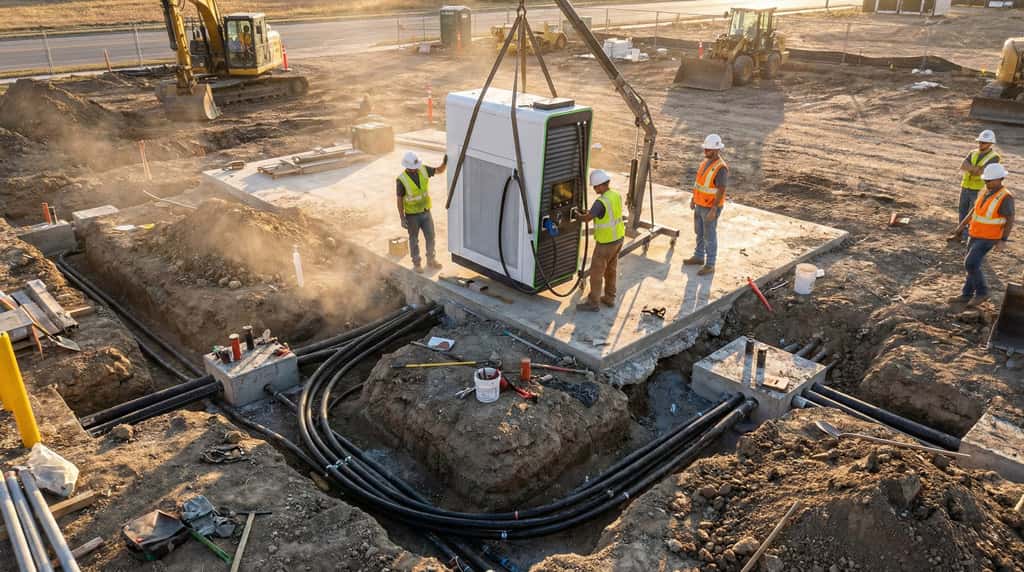
You likely see free Level 2 (AC) charging often, but rarely free DC Fast Charging (DCFC). Why?
The table below aggregates cost data from the ICCT (International Council on Clean Transportation) and 2025 Manufacturer Benchmarks:
| Cost Item | Estimated Cost Range (Per Unit/Site) | Source / Variance Factors |
|---|---|---|
| DCFC Hardware | $25,000 - $100,000+ | Manufacturer pricing (50-350kW). |
| Utility Upgrades | $15,000 - $70,000+ | Grid transformer & trenching (Site specific). |
| Construction & Labor | $10,000 - $30,000 | Professional electrician labor, concrete pads, bollards, canopies. |
| Soft Costs | $5,000 - $15,000 | Permitting, design, & utility application fees. |
| Annual OpEx | $3,000 - $8,000 /year | Network fees, preventive maintenance. |
Data Note: "Soft Costs" vary significantly by geography. For example, permitting fees and utility interconnection times in California can be 3x higher than the Midwest average due to stricter regulatory requirements.
1. Staggering Hardware & Energy Costs
•Expensive Equipment: A DC fast charger costs tens of times more than a slow charger. It contains complex power modules and liquid cooling systems.
•Demand Charge Surges: Fast charging draws massive energy from the grid instantly. This causes "Demand Charges" on the electric bill to skyrocket, sometimes exceeding the cost of the energy itself.
2. High Maintenance Difficulty
Fast chargers generate high heat, and components age faster. If open for free, high-frequency usage leads to a linear increase in failure rates.
How to Solve It? We use Smart Power Sharing Technology. When multiple vehicles charge simultaneously, the system automatically balances power to avoid excessive peaks, thereby lowering demand charges. This is the key technology to keep fast charging OpEx controllable.
VI. Incentive Stacking: Making "Time-Limited Free" Possible
Completely free charging is often unsustainable, but a "Smart Free" strategy—Incentive Stacking—can decentralize the cost burden. This isn't just simple addition; it's building a multi-party win-win ecosystem.
Imagine building with blocks:
•Block 1 (Foundation): Maximize Government Subsidies. Use national or local green infrastructure grants (like NEVI in the US or Green Funds in Europe) to cover most of the upfront hardware and installation costs (CapEx), allowing the project to start light.
•Block 2 (Revenue): Introduce Third-Party Sponsors. Install chargers with HD screens, converting wait time into ad exposure time. Local restaurants, insurance companies, or automakers are willing to pay for this traffic of high-net-worth car owners, covering daily energy and network fees (OpEx).
•Block 3 (Efficiency): Implement Time-Based Free Strategies. Set rules like "Free for the first 30-60 minutes, high price thereafter." This not only controls costs but, more importantly, acts as a "soft eviction" measure to prevent single vehicles from hogging spots for too long, improving turnover rates to serve more potential customers.
•Block 4 (Conversion): Consumption Validation Mechanisms. Tie charging privileges to in-store spending, for example, "Get a charging code with a $20 receipt." This effectively weeds out "freeloaders," ensuring every kWh given away brings back real in-store revenue growth.
The Result: Data referenced by the MIT Energy Initiative indicates that on-site EV charging can boost annual retail revenue by approximately $1,500 per customer. This revenue uplift is largely driven by the "Dwell Time Effect," as drivers spend significantly more while waiting for a charge (20-40 minutes longer than non-EV customers). This strategy fundamentally shifts the business model: instead of being a mere expense (cost center), the charging station becomes a powerful profit center—acting simultaneously as a foot-traffic engine, a digital billboard, and a consumer data hub.
VII. Manufacturer Perspective: How We Help You Make "Free Mode" a Reality
Choosing the right equipment manufacturer can directly determine whether your free business model is profitable or bankrupt.
As a factory, we save you money at the source:
1. Full-Spectrum Brand Customization
•Deep Customization Shapes Brand: We don't just offer simple white-labeling; we support full customization from the motherboard level to outer casing molds and logo materials. This gives your chargers a unique brand DNA, increasing brand recognition rather than being just another generic market product.
2. Commercial-Grade Connectivity & Protection
•OCPP Customization & Testing: We provide deep adaptation and rigorous testing for commercial-grade OCPP protocols, ensuring rock-solid communication between the charger and platform for smooth, reliable monitoring and operation.
•IP66 & IK10 Ultimate Protection: Adopting industry-leading protection standards effectively resists harsh environments and physical impacts. This not only extends charger life but drastically reduces later maintenance expenses (OpEx).
3. Smart Efficient Operations
•Load Balancing & Remote Support: Built-in Dynamic Load Balancing technology supports charging more vehicles without expensive power capacity upgrades; combined with efficient Remote Technical Support, we help you achieve the most efficient site operations at the lowest cost.
VIII. Practical Guide: How to Craft Your "Free/Partially Free" Strategy
formulating a strategy isn't just deciding between "free" or "paid"—it's finding the balance point that matches your business goals. As a business owner, here are our data-backed suggestions:
For Retailers (Supermarkets/Restaurants):
•Strategy: Recommend "Time-Limited Free + Overtime Fees." Free for the first 60 minutes precisely anchors the average shopping duration, boosting walk-in rates; high overtime fees serve as "soft eviction" to prevent long-term parking occupation.
•Equipment: Dual-Gun AC Chargers are the cost-effective choice. One charger with two guns maximizes space efficiency, and low-power slow charging perfectly matches shopping time, avoiding the high demand charges of fast charging.
For CPOs (Charging Operators):
•Strategy: Adopt "Membership Attraction + Ad Monetization." Use free charging on holidays or for first-time sessions to quickly acquire registered APP users. Convert wait times into advertising revenue.
•Equipment: Choose DC chargers equipped with High-Definition Ad Screens. Use screen ad revenue to offset high fast-charging electricity costs, closing the business model loop.
For Workplaces/Corporate Parks:
•Strategy: Implement a differentiated "Free Internal / Paid External" strategy. Free all day for employees as a benefit; fees for visitors to subsidize electricity.
•Equipment: The key lies in deploying charger clusters with Dynamic Load Balancing. Without expensive transformer upgrades, intelligently distribute power so limited grid capacity can meet the concentrated charging needs of dozens of cars during the morning rush.
IX. Is Your Site Suitable for Free Charging? Check These 5 KPIs
Before deciding to offer free charging, blind guessing is dangerous. You need to assess the effectiveness of this "marketing budget" based on precise data. We provide a visualized backend management system to help you monitor these 5 core KPIs that determine success or failure:
1. Daily Utilization Rate: According to Stable Auto's 2024 Utilization Analysis, a utilization rate of 15% is typically the tipping point for public charging stations to achieve profitability (or break-even).
Measurement Formula: (Hours Occupied / 24 Hours) × 100%
Analysis: If this metric is consistently below 5%, the site lacks necessary exposure; if above 30%, consider expansion to avoid queuing complaints.
2. Blended Cost per kWh: Don't just look at the flat energy rate. You must allocate monthly Demand Charges and fixed network fees to every kWh to see the real picture.
Calculation Formula: (Total Monthly Energy Bill + Demand Charges + Network Fees) ÷ Total kWh Dispensed
Analysis: This reveals your true Cost of Customer Acquisition (CAC). Only when this cost is lower than the profit from the customer's in-store spending is the "Free Model" sustainable.
3.Retail Conversion Rate: This is the soul of the free model. By linking charging data with POS systems, monitor how many "freeloaders" actually turn into "customers." If the conversion rate is low, you might need to adjust charger placement or change validation mechanisms (e.g., charge by receipt).
4.Uptime: Free does not mean low quality. A broken charger marked "Free" damages your brand more than having no charger at all. We ensure your equipment maintains an online rate of over 99%.
5.Payback Period: View the charger as a "salesperson." By calculating the additional traffic profit it brings, how long until you earn back the hardware investment? Typically, a well-designed free AC charger project should break even within 12-18 months.
FAQ
Q1: Are Tesla Superchargers free?
A: Most Tesla Superchargers require payment. Although some discontinued legacy vehicle models had promotional free access, the majority of current Tesla drivers pay for electricity usage just like at any other public station.
Q2: Why are some free electric vehicle charging points always broken?
A: This is often due to a lack of maintenance funding. Without a clear business model (like ads or retail traffic) to support it, owners are often unwilling to pay for repairs (OpEx). Choosing our high-reliability, low-maintenance equipment can alleviate this issue.
Q3: Can all electric vehicles use free charging stations?
A: This depends on the connector standard (e.g., CCS1, NACS, Type 2). As long as the connector matches, most public free AC charging stations are open to all vehicle models.
Q4: How do I find free EV charging stations on a map?
A: You can use apps like PlugShare or ChargePoint and select the "Free" option in the filters to find nearby free sites.
Q5: Can installing free chargers at a mall really earn back the electricity cost?
A: Data shows that retailers offering charging services see customer dwell time increase by an average of 50 minutes and spending increase by about 20%. For most high-margin retail businesses, this is enough to cover the cost of electricity.
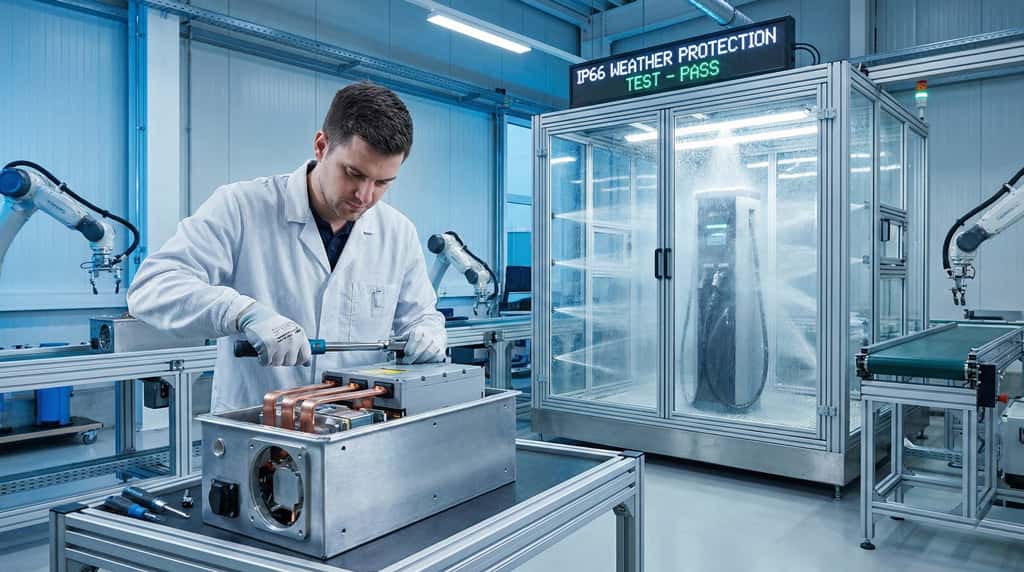
Free charging is not truly "zero cost"; it is the result of meticulous project design and efficient cost control.
To successfully operate a charging station with a free strategy in 2026, you need:
1.A business model with Incentive Stacking.
2.Correct Power planning.
3.Industrial-Grade Quality equipment to suppress long-term maintenance costs.
Don't let electricity bills eat your profits.
As a professional EV charger manufacturer, we don't just sell equipment; we provide you with lifecycle cost optimization solutions.
Contact Us Want to get a customized TCO (Total Cost of Ownership) Analysis Report? Or need a project proposal compliant with ISO 15118 and OCPP 2.0.1 standards? Click the button below to speak with our experts immediately. Let us help you build a charging network that is both popular and profitable.
Post time: Dec-11-2025