

Table Of Contents
Mode 1 EV Chargers
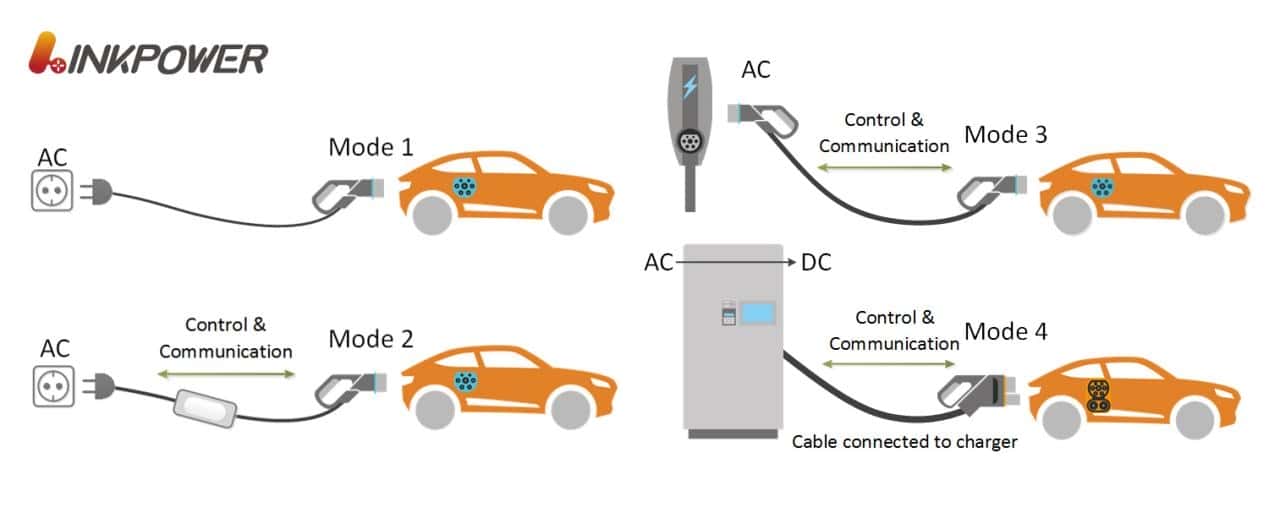
Mode 1 charging is the most basic and highest-risk form of charging. It involves connecting the EV directly to a standard household socket (230V AC in Europe, 120V AC in North America) often via an extension cord or basic plug. Mode 1 strictly lacks built-in protection and fails to meet modern EV charging safety standards. This mode is prohibited for EV charging by the North American National Electrical Code (NEC) and is heavily restricted by safety regulations in many jurisdictions. Given its safety concerns, we strongly advise against the routine use of Mode 1 charging.
Key Characteristics:
• Charging Speed: Slow (approximately 2-6 miles of range per hour of charging.
• Power Supply: Standard household socket, alternating current AC.
• Safety: Lacks integrated safety features, making it less suitable for regular use.
Mode 1 is often used for occasional charging, but it’s not ideal for daily use, particularly if you need faster recharges or require higher safety standards. This type of charging is more common in locations where more advanced charging options are unavailable.
Mode 2 EV Chargers
Mode 2 charging improves upon Mode 1 by integrating a Control Box (IC-CPD, or In-Cable Control and Protection Device) into the charging cable. Defined by the IEC 61851-1 standard, this mode utilizes standard household outlets or higher-power receptacles (like NEMA 14-50). It is not used for dedicated Mode 3 charging stations. The IC-CPD includes an RCD (Residual Current Device) and a Pilot Signal for essential safety and communication.
Key Characteristics:
• Charging Speed: Varies significantly by receptacle type. On a North American 120V outlet, expect 4-8 miles/hour; on a 240V/40A (NEMA 14-50) receptacle, speeds can reach 25-40 miles/hour.
• Power Supply: Can use a standard household socket or a dedicated charging station with alternating current AC.
• Safety: Includes built-in safe and efficient charging features like an RCD for better protection.
Mode 2 is a more versatile and safer option compared to Mode 1 and is a good choice for home charging when you need an easy solution for overnight recharges. It's also commonly used in public charging points that offer this type of connection.
Mode 3 EV Charger
Mode 3 charging is the most widely adopted EV charging mode for public charging infrastructure. This type of charger uses dedicated charging stations and charging points equipped with AC power. Mode 3 charging stations feature built-in communication protocols between the vehicle and the charging station, which ensure optimal safety and charging speeds. The vehicle’s onboard charger communicates with the station to regulate the power flow, providing a safe and efficient charging experience.
Key Characteristics:
• Charging Speed: Faster than Mode 2 (typically 30-60 miles of range per hour).
• Power Supply: Dedicated charging station with alternating current AC.
• Safety: Advanced safety features, such as automatic cut-off and communication with the vehicle, to ensure a safe and efficient charging process.
Mode 3 charging stations are the standard for public charging, and you’ll find them at various locations, from shopping centers to parking lots. For those with access to home charging stations, Mode 3 provides a faster alternative to Mode 2, reducing the time spent recharging your EV.
Mode 4 EV Charger
Mode 4, or DC Fast Charge, is the fastest and most advanced form of charging. The external station converts AC grid power to Direct Current (DC) and feeds it directly to the battery, bypassing the vehicle's onboard charger, via high-power dedicated connectors (such as CCS, CHAdeMO, or NACS). Mode 4 follows standards like IEC 61851-23, with power typically ranging from 50 kW up to 350 kW and beyond.
Key Characteristics:
• Charging Speed: Very fast (up to 200 miles of range in 30 minutes).
• Power Supply: Dedicated charging station that delivers direct current DC power.
• Safety: Advanced protection mechanisms ensure safe and efficient charging even at high power levels.
•Battery Performance Protection - Even though Mode 4 is extremely fast, the system strictly limits charging speed after 80% SOC (State of Charge). This is a deliberate measure to protect battery longevity, prevent thermal runaway from high temperatures, and extend the return on investment.
Mode 4 is ideal for long-distance travel and is used for public charging in locations that require rapid turnaround times. If you're traveling and need to recharge quickly, DC fast charge is the best option for keeping your vehicle moving.
Comparison of Charging Speeds and Infrastructure
When comparing charging speeds, Mode 1 is the slowest, offering minimal miles of range per hour of charging. Mode 2 charging is faster and safer, especially when used with the control box that adds extra safety features. Mode 3 charging provides faster charging speeds and is often used at public charging stations for those in need of quicker recharges. Mode 4 (DC fast charge) offers the fastest charging speeds and is essential for long trips where quick recharges are necessary.
The charging infrastructure for Mode 3 and Mode 4 is expanding rapidly, with more fast charging stations and dedicated charging stations being built to accommodate the growing number of electric cars on the road. In contrast, Mode 1 and Mode 2 charging still rely heavily on existing home charging options, with standard household socket connections and the option for mode 2 charging through more secure control boxes.
Conclusion
Summarizing all EV charging modes, Mode 3 represents the optimal balance of safety, efficiency, and ubiquity. We recommend that all homeowners and installers prioritize Mode 3 EVSE.
Critical Safety Disclaimer: Given that EV charging systems involve high-voltage electricity, all installations must be performed by a licensed electrician and strictly comply with local National Electrical Code (NEC) or IEC 60364 standards. The information provided herein is for informational purposes only and does not constitute professional electrical engineering advice.
Post time: Nov-13-2024