

China Wall Charger Manufacturers
The wall charger is the least glamorous product in EV charging and the one that decides whether your installation passes inspection. Everything that matters about a wall unit is invisible in a product photo: the supply configuration, the earthing scheme, the cable temperature rise, and what the unit does when the grid browns out.
Most wall charger failures are not electronic. They are the result of specifying a 22 kW unit onto a supply that cannot deliver it, or fitting a tethered cable in a car park where the cable gets driven over twice a year.
The specification that matters, in order
| Parameter | What to specify | Why it decides the outcome |
|---|---|---|
| Output | 7 kW single-phase / 11 kW or 22 kW three-phase | 11 kW needs three-phase; a single-phase site physically cannot reach 22 kW |
| Connector | Type 2 tethered or socket; Type 1 or NACS for North America | Tethered suits fleets and shared parking; sockets suit public sites |
| Earthing | Type A RCD + DC 6 mA detection, or Type B RCD upstream | Missing DC leakage protection is the most common inspection failure |
| Load management | Dynamic load balancing, CT-clamped, per-site | Lets you install more units without a supply upgrade |
| Enclosure | IP54 indoor / IP65 outdoor, IK08 impact where public | Car park units fail on impact and water ingress, not on electronics |
| Smart features | OCPP 1.6J minimum, RFID, MID metering if you bill | Non-OCPP units cannot be aggregated or billed without swapping hardware |
Read row three before you read row one. The most expensive retrofit in this category is not a bigger charger — it is the electrician returning to correct the protection scheme after the inspector rejects the installation.
Where 22 kW units quietly underperform
Three constraints cap real-world output well below the badge:
- The vehicle. Many models accept 11 kW on AC and will never draw 22 kW, regardless of the charger.
- The supply. 22 kW requires roughly 32 A per phase on three phases. A site with a 63 A service feeding lighting and HVAC cannot support several of them at once without load balancing.
- The cable. Tethered 7 m cables at 32 A get warm; the connector's temperature sensor will derate the session before the electronics do.
Practical rule: specify 22 kW where dwell time is short and the supply is genuinely three-phase; specify 11 kW everywhere else and spend the difference on more points. Two 11 kW points serve more vehicles per day than one 22 kW point in almost every workplace and retail scenario.
What we manufacture
Our AC range covers single-phase 7 kW and three-phase 11/22 kW wall and pedestal units, tethered or socketed, in Type 1, Type 2 and NACS configurations:
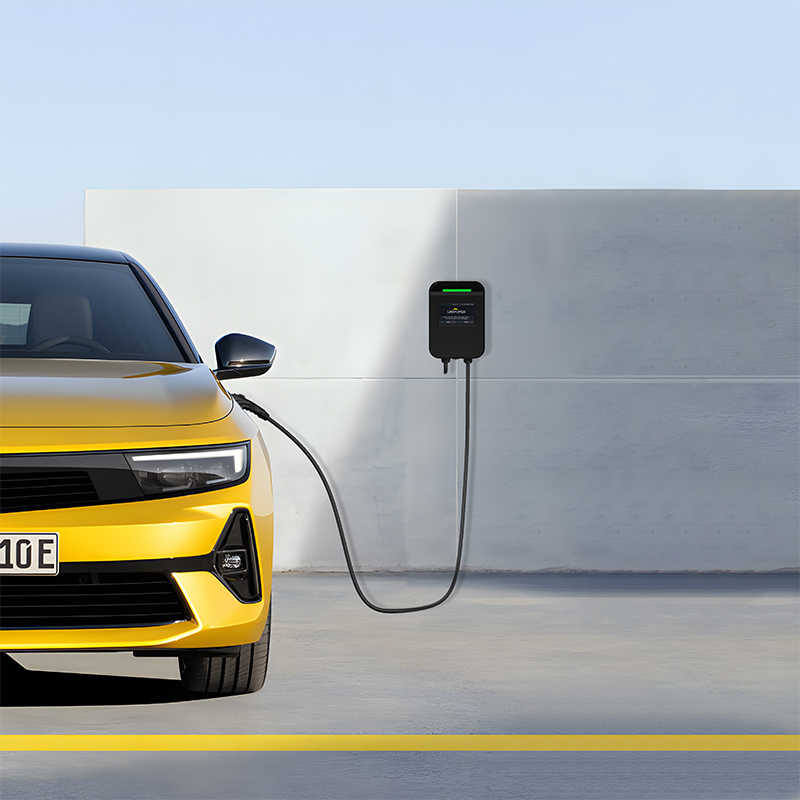
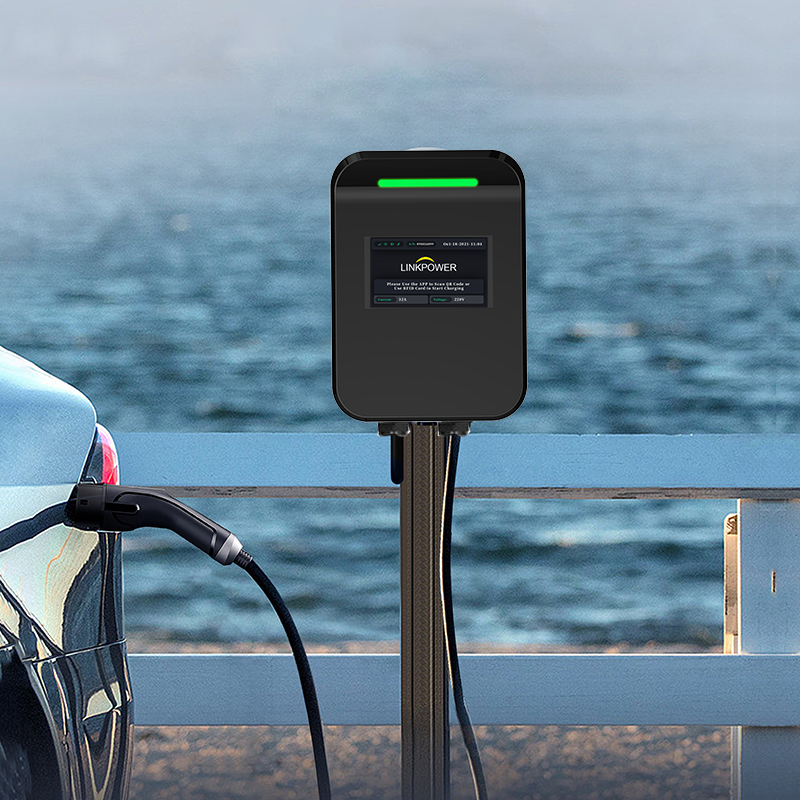
- 32A wall unit with app and digital screen — residential and light commercial.
- Pedestal-mounted 7–19.2 kW unit — car parks and forecourts.
- Mode 3 public unit with 5 m or 7 m cable, Type 2 — EU public and workplace sites.
- Dual-port advertising unit — retail and hospitality, where the screen pays for part of the hardware.
Each listing states per-unit current, connector type, protection scheme and OCPP version, because those four lines are what an installer actually needs to quote the job.
Two claims worth correcting
First: "plug-and-play" is a phrase from the consumer market and does not survive contact with a commercial installation. Every commercial wall unit needs a dedicated circuit, correct upstream protection and a commissioning step that confirms the earth path. A unit marketed as plug-in for a 32 A circuit still needs a qualified electrician.
Second: a higher IP rating does not make a unit vandal-proof. IP65 addresses water and dust; public car parks need impact resistance and a mounting height that keeps the connector out of a bumper's path. Those are installation decisions, not product features.
Specification checklist for installers
- Supply confirmed as single or three-phase before the model is chosen.
- Protection scheme documented: RCD type, DC leakage detection, upstream breaker rating.
- Load balancing requirement identified, with CT placement agreed with the site owner.
- Connector standard matched to the vehicles actually parking there — including any NACS transition.
- OCPP version and backend confirmed, with a test session before handover.
- Mounting height and cable management agreed for public sites, not assumed.
Wall chargers are simple machines. The projects around them are not, which is why the specification list matters more than the datasheet.
Related Products


Top Selling Products



- Related Blog
- Reviews
